The Road to ELO 2000 - the New Unknown in My Chess Journey
Building upon the lessons learned from my previous pursuit, I continue to push the boundaries of my chess understanding, exploring the unknown in openings and strategies.

Another week is gone - you might have recognized some site improvements and fancy images, such as the white pawn. By the way, the White Pawn App for the ChessNut Air e-board is great, but that’s content for another blog post.
In my previous post, “The Road to ELO 2000 - Unlearning and Rediscovering Openings”, I started the journey of unlearning and rediscovering openings to elevate my chess game. And it is not a big surprise; it’s all about building a new repertoire that fits your personal style.
Personal Statement
Already in the process of developing a repertoire, one should create one’s signature. The psychological factors also play a not insignificant role. Behind all variants hides a rational core. Memorizing any openings to the fullest is unnecessary, as with Chesssable, where people learn and memorize moves, for example. I tried Chessable for a while but found it a stupid and boring way to learn. Yes it might be it’s my learning style because others embrace it.
Ask yourself: which picture would I like to have to start the middle game? Which position suits my style best? Even in-game practice, only some things always run in theoretical directions, even between high-class chess players.
Embracing the Unknown
Now, let’s take a closer look at the potential new black repertoire in response to the most common openings for white: e4 or d4. The thought process and insights from my lost games led me to find openings that align with my style of play while offering flexibility and transposition to get a position familiar with. For e4, I settled on the Pirc Defense—a choice that might not be frequently seen at the GM level but was even favored by the legendary Bobby Fischer in the “Match of the Century.” The Pirc is the King’s Indian Defense without White’s pawn on c4. Plans and ideas are very similar, and learning one defense is easier if you already know the other.
Reflecting on the Path Traveled
Reflecting on my journey toward surpassing the ELO 2000 barrier, I am reminded of the valuable lessons I’ve gathered. Shedding deeply ingrained opening patterns was both challenging and profoundly rewarding. It provided me with a fresh perspective, free from the constraints of routine moves. The Reti, English, King’s Indian, and Pirc openings became my canvas, and I charted a new course with determination.
Also, the Modern defense, the Philidor, the King’s Indian Attack, and the Reti are like brothers of the Pirc.
The Creative Adaptation
This blog isn’t a comprehensive opening strategy guide — I’m neither a grandmaster nor a coach. However, I hope my approach can offer insights to help you elevate your own game. The fundamental idea in response to white’s e4 and black’s Pirc Defense can be summarized as follows:
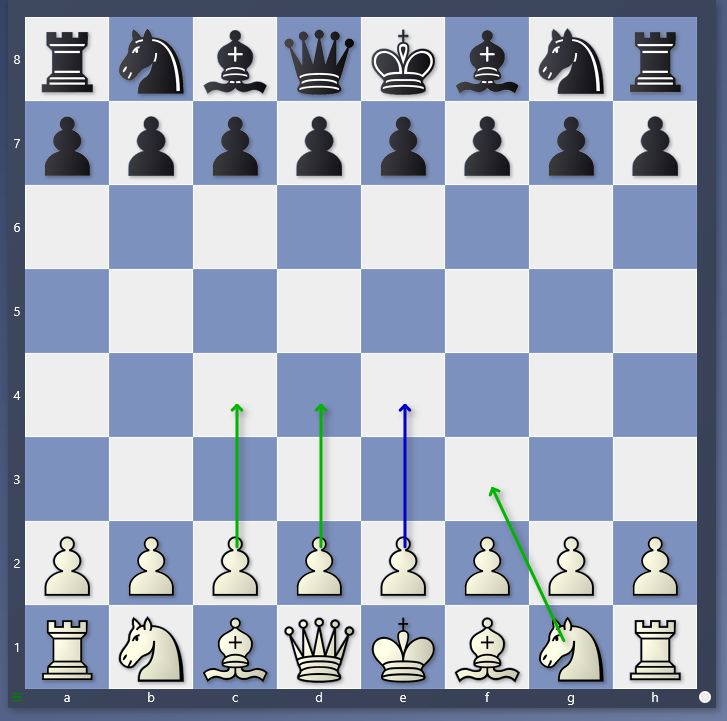
And black’s response
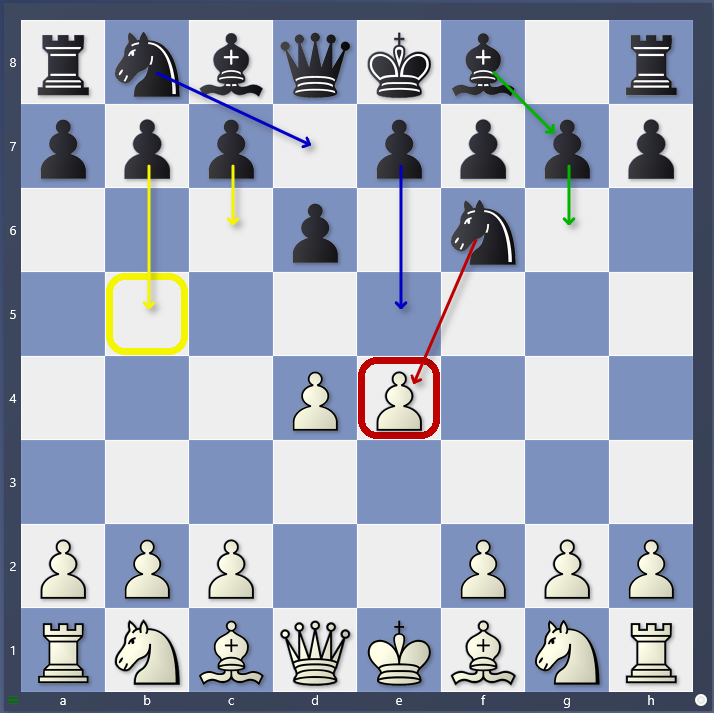
That’s the main line and main idea. And it comes with some risks for sure. Giving up the center in the first approach requires carefully developing the pieces.
This approach has not only enriched my strategic toolkit but has also injected an element of unpredictability into my games. For a detailed breakdown of this strategy, I recommend checking out the ChessBase YouTube show “Svitlana’s Smart Moves,” where the concept is explained alongside iconic games like Kasparov vs. Topalov and Fischer vs. Spassky.

Svitlana’s Smart Moves - The Pirc Defence
I highly recommend to check out more episodes of “Svitlana’s Smart Moves” with Svitlana Demchenko and Arne Kaehler. It’s so well done!
Building a Repertoire for Black
Here is an example to showcase. White’s response is called the “Austrian Attack - I. A. 6. e5 Nfd7
[Event ""]
[White "Pirc Defence: Austrian"]
[Black "Attack   I. A. 6. e5 Nfd7"]
[Site ""]
[Round ""]
[Annotator ""]
[Result "0-1"]
[Date "2022.10.16"]
[PlyCount "28"]

1. e4 d6 2. d4 Nf6 {We start with our Pirc set-up. our knight attacks e4, so
White should defend.} 3. Nc3 (3. e5 $2 {would lead to trouble for white...} dxe5
4. dxe5 Qxd1+ 5. Kxd1 Ne4 {with an advantage.} )g6 {We build our strong
fianchetto on the Kingside.} 4. f4 {in this variation the basic idea is shown
best. White likes to respond to the defensive approach of Black with a full
attack. The setup is called Austrian attack} Bg7 5. Nf3 ({1)} 5. e5 dxe5 6. dxe5
Qxd1+ 7. Kxd1 Ng4 8. Ke1 f6 $1 9. h3 Nh6 10. exf6 exf6 11. g4 Be6 12. Nf3 Nc6
13. Be3 O-O-O {0-1 Tompa,J-Sapi,L HUN-ch26 Budapest 1970 equal position} )({2)}
5. Bc4 c5 6. e5 Nfd7 7. Nf3 cxd4 8. Qxd4 O-O {½-½ Ljubojevic,L-Jansa,V
Olympiad-20 Final A Skopje 1972 (2) with complicated game} )O-O (5... c5 {1)} 6.
dxc5 ({2)} 6. Bb5+ Bd7 7. e5 Ng4 8. h3 $1 cxd4 9. Qxd4 Bxb5 10. Nxb5 Nc6 11. Qe4
Qb6 $1 12. Qe2 Nh6 13. Be3 Qa5+ 14. Bd2 Qb6 15. g4 $2 dxe5 16. fxe5 a6 17. Nc3
Qxb2 18. Rb1 Qxc2 19. Kf2 Rd8 20. Rhc1 Qd3 21. Qxd3 Rxd3 22. Rxb7 O-O 23. Nb1 f5
{Grodzensky,S-Kudinov,I corr 1975 and Black has the initiative} )Qa5 7. Bd3 Qxc5
8. Qe2 O-O 9. Be3 Qa5 10. O-O Bg4 11. Rad1 Nc6 12. Bc4 Nh5 {Fischer's idea} 13.
Bb3 Bxc3 14. bxc3 Qxc3 15. f5 Na5 16. Bd4 Qc7 {0-1 Gligoric,S-Hort,V Olympiad-20
Final A Skopje 1972 (2)} )6. e5 {The sharpest weapon against black. White likes
to strangle Black in the center, then move to king side attack.} Nfd7 7. h4 {1-0
Bronstein,D-Palmiotto,F Olympiad-13 Preliminaries A 1958 (4) Bronstein played
this move first 1958 against Palmiotti in Munich} c5 8. h5 cxd4 {now White need
to decide moving forward with Qxd4 or sacrifice a piece with hxg6 a)} 9. Qxd4
({b)} 9. hxg6 {a sharp continuation and more complications} dxc3 10. gxf7+ Rxf7
11. Bc4 {0-1 Sutovsky,E (2700)-Ivanchuk,V (2768) FIDE World Cup Khanty-Mansiysk
2011 (3.2)} Nf8 12. Bxf7+ Kxf7 13. Ng5+ Kg8 14. Qh5 h6 15. Qf7+ Kh8 16. Qb3 $1
Qa5 17. Nf7+ {½-½ Nadyrhanov,S (2467)-Tseshkovsky,V (2556) Sarkisov Memorial
Krasnodar 1999 (3.2) White can now give permanent chess, which seems to be the
best} )dxe5 10. Qf2 $1 e4 $1 11. Ng5 Nf6 12. hxg6 hxg6 13. Ncxe4 Nxe4 14. Nxe4
Qd4 $1 {Black stopped the attack, position is equal} 0-1
Source: Aleksei Suetin, Lehrbuch der Schachtheorie Band 1, page 326
For my repertoire, I entered all variations like the above into the pgn, analyzed them, and added the line to my repertoire database.
- Austrian Attack - I. A. 6. e5 Nfd7
- Austrian Attack - I. B. 6. Be2 c5!
- Austrian Attack - I. C. 6. Bd3 Nc6!
- Austrian Attack - I. D. Be3 Nc6
- Austrian Miscellaneous Systems - II. 5. Bf4 Bg7
- King’s Indian: Sämisch: 6th move deviations incl. 6.Be3
- Pirc Defence: Classical System - IV. 5. Be2 0-0
ChessBase will save your game with the variations already stored in the repertoire database and will suggest merging the two games in the repertoire database if the game is very similar to an existing repertoire game. You can let it do so or overrule it and save the game as a separate entry. If your game contains an entirely new line, the program will keep it as a new game. It will suggest a suitable name (e.g., “Pirc Austrian Attack”).
If no repertoire database exists, ChessBase will automatically create one and add an icon to your database window.
While working on my repertoire, I had a good laugh when I came across the following statement on the chess.com website:
The Pirc Defense is relatively new and not as heavy on theory as other classical openings.
Dear chess.com, do your homework! This opening was already utilized in the 18th century. Back then, such a style of play was considered unconventional. It was in the late 1930s that it started gaining more attention. In the former USSR, Ufimtsev explored it, and in the then Yugoslavia, it was Grandmaster Pirc. The opening gained popularity during the 1960s.
Earliest games Pirc Defense - Austrian Attack:
| No. | Result | Players | Year |
|---|---|---|---|
| 1 | 1-0(23) | Marshall 2570 - Pillsbury 2630 | 1904 |
| 2 | 0-1(28) | Richter 2525 - Lokvenc 2490 | 1938 |
| 3 | 0-1(60) | Honfi 2560 - Koberl 2560 | 1950 |
| 4 | 0-1(39) | Teschner - Tartakower | 1951 |
| 5 | 1-0(32) | Matanovic - Tartakower | Birmingham 1951 |
You can then take it from there, build your repertoire matching your style and thoughts and do your repertoire training showcased in this YouTube video:

If you need to learn how to build your repertoire database - yes, another of those not well-documented functions - this will be shown in another blog. Even on YouTube, you need help finding such how-to videos for the amateur.
While embracing the unknown has its rewards, it’s challenging. There were moments of uncertainty and setbacks, and a move I had not encountered left me pondering for minutes. However, these challenges are integral to growth. Every encounter with the unfamiliar is an opportunity to learn, adapt, and improve. And with time, I became more confident in navigating unexplored openings. I also modified the standard path and adjusted it based on learnings.
You might want to check out such a game in my blog Amici Sumus: Finding Unity and Strength in Chess - My Journey at the Peace Open Tournament.
Roberto Pinos Rubio’s feedback to me was golden and spot on.
Famous Game Example: Fischer-Spassky - Match of the Century 1972
[Event "World-ch27 Fischer-Spassky +7-3=11"]
[Site "Reykjavik"]
[Date "1972.08.22"]
[Round "17"]
[White "Spassky, Boris Vasilievich"]
[Black "Fischer, Robert James"]
[Result "1/2-1/2"]
[ECO "B09"]
[BlackElo "2785"]
[Annotator "Schroeer,Egbert"]
[PlyCount "89"]
[EventDate "1972.07.11"]
[EventType "match"]
[EventRounds "21"]
[EventCountry "ISL"]
[SourceTitle "MainBase"]
[Source "ChessBase"]
[SourceDate "1999.07.01"]
[SourceVersion "2"]
[SourceVersionDate "1999.07.01"]
[SourceQuality "1"]

1. e4 d6 {Fischer never played the Pirc defense before} 2. d4 g6 3. Nc3 Nf6 4.
f4 {Spassky never played this line before} Bg7 5. Nf3 c5 6. dxc5 Qa5 7. Bd3 Qxc5
8. Qe2 O-O 9. Be3 Qa5 10. O-O Bg4 11. Rad1 $146 (11. h3 Bxf3 12. Qxf3 Nc6 13.
Kh1 Nd7) ({Predecessor:} 11. h3 Bxf3 12. Qxf3 Nc6 13. Kh1 Nd7 14. Bd2 Nc5 15. a3
Nd4 16. Qe3 Nxd3 17. Qxd3 Qd8 18. Rad1 Rc8 19. Nd5 e6 20. Ne3 f5 21. c3 fxe4 22.
Qxe4 {½-½ Andersson,U-Ljungqvist,L SWE-ch Sundsvall 1969}) 11... Nc6 {B09: Pirc
Defence: Austrian Attack.} 12. Bc4 Nh5 $5 13. Bb3 $5 Bxc3 14. bxc3 Qxc3 15. f5
Nf6 $5 16. h3 Bxf3 17. Qxf3 Na5 $1 18. Rd3 Qc7 19. Bh6 Nxb3 20. cxb3 (20. axb3
Qc5+ 21. Kh1 Qe5) 20... Qc5+ 21. Kh1 Qe5 {[%cal Yf6e4]} 22. Bxf8 Rxf8 23. Re3
Rc8 24. fxg6 $6 hxg6 25. Qf4 Qxf4 26. Rxf4 $10 {Endgame. KRR-KRN} Nd7 $1 27. Rf2
Ne5 28. Kh2 Rc1 29. Ree2 {Strongly threatening Rc2.} Nc6 30. Rc2 Re1 31. Rfe2
Ra1 32. Kg3 Kg7 {...Nd4 would now be deadly.} 33. Rcd2 {Prevents Nd4} Rf1 34.
Rf2 Re1 35. Rfe2 Rf1 36. Re3 a6 37. Rc3 Re1 38. Rc4 Rf1 39. Rdc2 Ra1 40. Rf2 Re1
41. Rfc2 g5 42. Rc1 Re2 43. R1c2 Re1 44. Rc1 Re2 45. R1c2 {Weighted Error Value:
White=0.06 (flawless) /Black=0.05 (flawless) . Inaccurate: White=1 --- OK:
White=12 Black=16} 1/2-1/2
Looking Ahead
My chess journey is far from over. Pursuing improvement is a lifelong endeavor, and with each milestone reached, new horizons open up. As I continue to evolve as a player, I’m excited to dive even deeper into the uncharted waters of chess openings, strategies, and tactics. The road ahead is filled with growth opportunities, and I’m excited to learn more and improve.
Thank you to everyone who has been a part of my journey so far. Your support, feedback, and camaraderie mean the world to me. If you have questions or topics you want to explore, let me know, drop me a note.
Stay tuned for more updates, analyses, and insights as I venture further into the world of chess. Until then, may your games be inspired and your moves with purpose.
Keep evolving, keep playing, and keep discovering.
Amici Sumus